August marks the peak of Atlantic hurricane season, and for Brevard County rental owners it is the single most important month to get insurance right. The Space Coast sits low and close to the water - the Atlantic on one side, the Indian River Lagoon and Banana River on the other - which means storm surge and flash flooding are the real threats, often more damaging to a rental than wind alone. The problem most owners discover too late is simple: standard landlord and homeowners policies do not cover flood. This guide walks through how to protect a Space Coast rental before the next system spins up in the Atlantic.
This article is general information for property owners, not insurance advice. Coverage terms vary by policy and carrier - confirm your specifics with a licensed Florida insurance agent.
Why standard policies leave a Brevard gap
A landlord policy - often a DP-3 dwelling policy - covers wind, fire, theft, and liability. What it explicitly excludes is rising water, and that includes storm surge, an overflowing lagoon, and water that pools from torrential rain. So when owners ask does landlord insurance cover flood damage, the honest answer is no. Wind damage to the roof, generally yes. The two feet of water that soaked the drywall in Merritt Island, no.
This is the coverage gap that catches Space Coast owners every year. If your rental is anywhere near the barrier islands, the Indian River Lagoon, Cocoa Beach, Satellite Beach, or the low-lying neighborhoods of Melbourne and Palm Bay, flood is not a remote risk - it is the expected one.
Flood damage from a hurricane is not covered by your regular landlord policy. Storm surge, rising water, and heavy-rain flooding all require a separate flood policy. Confirm you have one in force before the peak weeks of the season.
NFIP vs. private flood insurance
Space Coast owners generally have two roads to flood coverage:
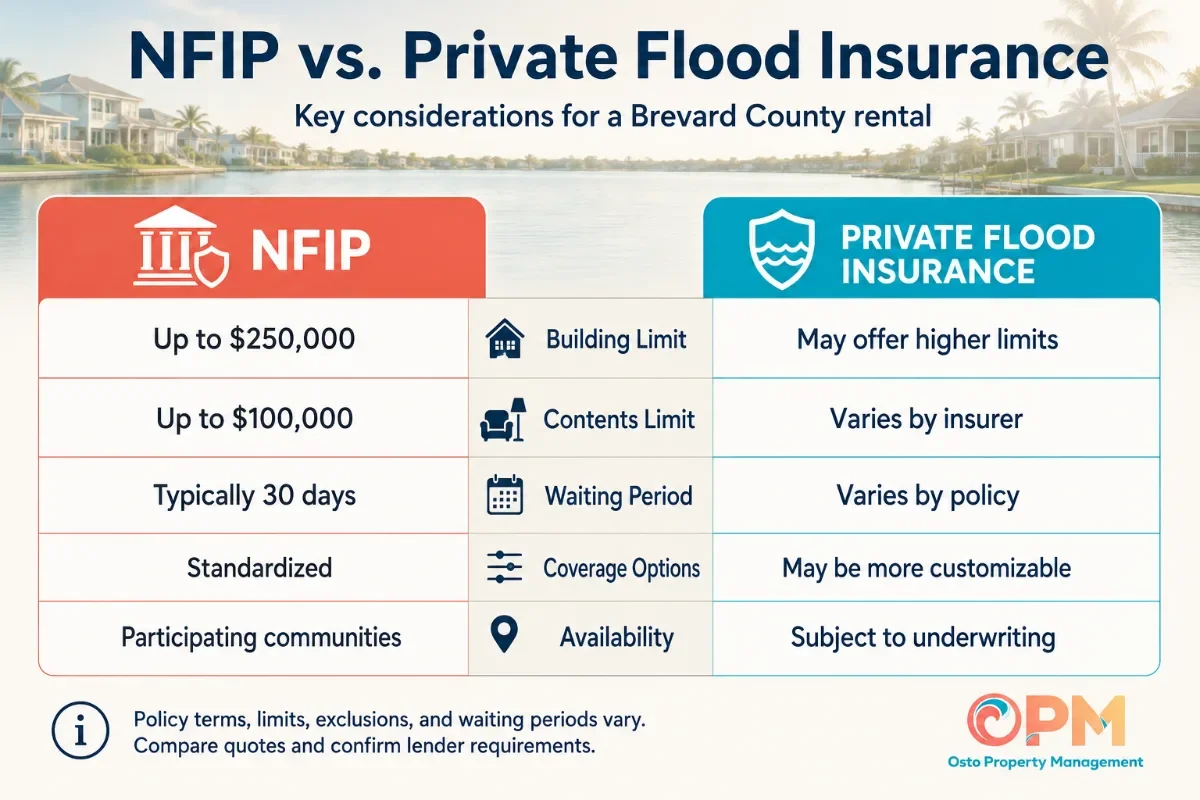
- NFIP (National Flood Insurance Program). The federal program administered through FEMA. Building coverage is capped at $250,000 for residential structures, with a separate limit for contents (which, as a landlord, you would carry only for owned items in the unit). Rates are tied to FEMA's newer Risk Rating 2.0 methodology, which prices each property on its own flood risk.
- Private flood insurance. A growing market in Florida that can offer higher limits, replacement-cost options, and sometimes lower premiums than the NFIP - useful for higher-value coastal rentals that exceed NFIP caps.
Many lenders accept either, as long as the coverage meets their requirement. It is worth quoting both.
Know your Brevard flood zone
Every property on the Space Coast falls into a FEMA flood zone, and that zone drives both whether coverage is required and what it costs. High-risk zones (labeled with an "A" or "V") mean a federally backed mortgage lender will require flood insurance. Moderate- and low-risk zones (X) do not carry the mandate, but plenty of Brevard flooding happens outside mapped high-risk zones - especially from stalled tropical rain.
Look up any address on FEMA's flood map service before you assume you are safe. A property two blocks off the lagoon can price very differently from one on the water, and a current elevation certificate can meaningfully lower a premium.
Pull the FEMA flood map for the exact address, not the neighborhood. Elevation, distance from water, and the base flood elevation all move the premium - and an elevation certificate can save real money on an older Brevard home.
Hurricane deductibles work differently in Florida
Florida policies carry a separate hurricane deductible that is triggered when the National Hurricane Center names a storm affecting the state. Unlike a flat dollar deductible, it is usually a percentage of the dwelling's insured value - commonly 2%, 5%, or 10%. On a $400,000 insured rental, a 5% hurricane deductible is $20,000 out of pocket before wind coverage pays.
That deductible applies to your wind/dwelling policy. Your separate flood policy has its own deductible. After a major storm, a Brevard owner can face both at once, so budget a reserve accordingly.
Require renters insurance from your tenants
Your building coverage stops at the structure. A tenant's furniture, electronics, and belongings are their responsibility - and after a flood, an uninsured tenant is a frustrated tenant. Understanding renters insurance vs landlord insurance is worth a short conversation at lease signing: your policy protects the building; theirs protects their stuff and can add liability protection that benefits everyone.
Making renters insurance a lease requirement is standard practice for professionally managed Space Coast rentals, and it reduces post-storm disputes.
What to do before and after a storm
- Before the season peaks: confirm flood coverage is active (remember the 30-day NFIP wait), photograph the property inside and out, and store policy numbers and your agent's contact somewhere you can reach from your phone.
- After a storm: document damage before cleanup, keep receipts for emergency mitigation (tarping, water extraction), and file the flood and wind claims separately with the correct carrier. Mitigate further damage promptly - most policies require it.
Osto PM helps Brevard County owners keep coverage current, coordinate documentation, and handle the post-storm scramble so a hurricane does not become a financial one. Reach out about our owner services on the Space Coast.
Frequently Asked Questions
Does landlord or homeowners insurance cover flood damage in Florida?
No. Standard landlord (dwelling) and homeowners policies exclude flood damage - including storm surge and rising water from heavy rain. You need a separate flood policy through the NFIP or a private insurer to be covered.
Is flood insurance required for Brevard County rental properties?
Florida does not require it by statute, but your lender will require it if the property sits in a FEMA high-risk flood zone (an 'A' or 'V' zone) and carries a federally backed mortgage. Given the Space Coast's low elevation and Atlantic and Indian River Lagoon exposure, most owners should carry it regardless.
What is the difference between flood insurance and windstorm coverage?
Windstorm covers wind-driven damage - roof loss, wind-blown rain through a breach. Flood covers rising water and storm surge from the ground up. In Florida these are usually two separate policies or endorsements, and a single hurricane can trigger both.
How long does an NFIP flood policy take to take effect?
There is typically a 30-day waiting period before a new NFIP policy is active. You cannot buy coverage as a storm approaches, so bind it well before the August-October peak of Atlantic hurricane season.
Who insures a tenant's belongings after a flood?
Your policy covers the building; it does not cover the tenant's personal property. Tenants need their own renters insurance with contents coverage. Requiring renters insurance in the lease is smart risk management for Brevard owners.