
Florida has no state income tax, which is a real perk of owning a rental on the Space Coast. But your rental income is still taxable at the federal level, and that is exactly why deductions matter so much: every legitimate write-off lowers the income you are taxed on. Brevard County landlords who track expenses carefully often keep thousands more each year than those who don't. This guide walks through the deductions that most commonly apply to a Space Coast rental.
This article is general information, not tax advice. Tax situations vary and the rules change - consult a licensed CPA or tax professional before filing.
First, is your rental income taxable?
Yes. When owners ask is rental income taxable, the answer is that rent you collect is reported on Schedule E of your federal return, and you pay federal income tax on the net - that is, rent received minus deductible expenses. Because Florida levies no personal income tax, your Brevard rental only faces the federal side, which makes maximizing deductions the main lever you control.
Keep security deposits out of income unless you keep part of one (for damage or unpaid rent) - only the portion you retain becomes taxable income that year.
Mortgage interest
For most owners, mortgage interest is the largest deduction. You can generally deduct the interest on a loan used to buy, build, or improve the rental. Your servicer sends a Form 1098 each January showing the interest paid. Note that the principal portion of your payment is not deductible - only the interest.
Mortgage interest and depreciation are usually the two largest deductions on a Brevard rental - and neither requires new out-of-pocket spending at tax time. Track them first.
Depreciation - the deduction owners forget
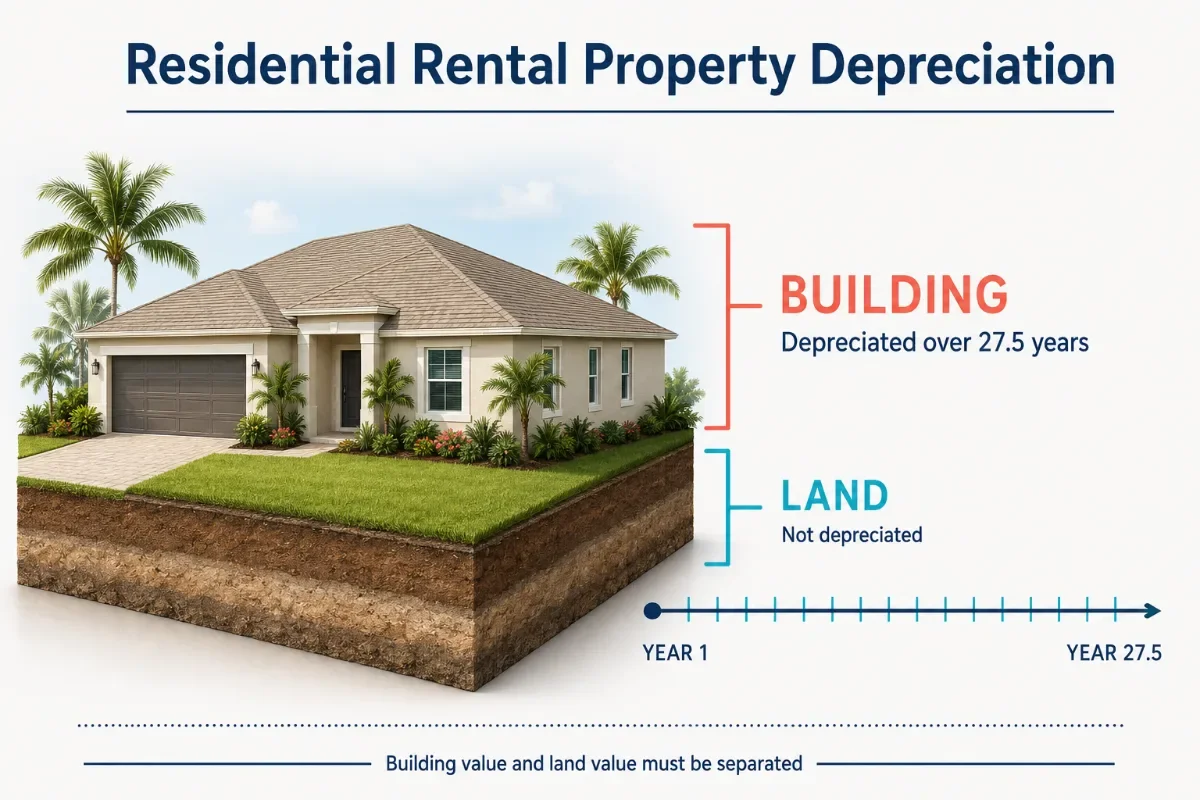
Depreciation lets you recover the cost of the building over 27.5 years for residential rental property. You separate the land value (which is not depreciable) from the structure, then deduct a portion of the building's cost each year. On the Space Coast, where land near the water can be a large share of a property's value, getting that split right matters.
Depreciation is powerful because it is a non-cash deduction - you lower taxable income without writing a check. Just know that depreciation is "recaptured" when you sell, so loop in your CPA on the long-term picture.
Repairs vs. improvements
This is the distinction that trips up new landlords. A repair keeps the property working - patching drywall, fixing an AC compressor, repainting a unit between tenants - and is usually fully deductible the year you pay for it. An improvement adds value or extends the property's useful life - a new roof after a storm, impact windows, a kitchen remodel - and must be capitalized and depreciated over time.
Given how hard Brevard's climate is on roofs, HVAC, and exteriors, owners here spend a lot in this category. Coding each expense correctly protects the deduction.
After a hurricane, a single invoice can include both deductible repairs and depreciable improvements. Ask your contractor to itemize, and have your CPA classify each line - it changes when you get the deduction.
Operating expenses you can write off
Beyond the big two, a long list of ordinary operating costs are deductible against rental income:
- Property management fees - a fully deductible cost of professional management, along with leasing and advertising fees.
- Insurance premiums - landlord/dwelling, flood, and windstorm coverage on the rental.
- Repairs and maintenance - lawn care, pest control, pool service, HVAC servicing, cleaning.
- Property taxes - Brevard County real estate taxes on the rental.
- Utilities you pay - any water, electric, or trash you cover rather than the tenant.
- Professional and legal services - CPA fees, attorney fees, tenant-screening costs.
- Travel and mileage - trips to the property for management, maintenance, or showings, at the IRS standard mileage rate.
- HOA or condo association dues on the rental.
Don't overlook the pass-through and loss rules
Two federal provisions are easy to miss. First, rental activity can qualify for the Qualified Business Income (QBI) deduction - up to 20% of net rental income for owners who meet the requirements, which your CPA can assess. Second, rental losses are generally passive, meaning they can only offset passive income unless you actively participate and fall under the income threshold that allows a limited special allowance. When a hard storm year pushes a Space Coast rental into a paper loss, understanding whether you can use it now or must carry it forward is worth a conversation with your tax professional.
Recordkeeping best practices
Deductions are only as good as your documentation. Keep a dedicated bank account and card for the rental, save every receipt and invoice, log mileage as you drive, and retain records for at least the period the IRS can audit. Owners who use a professional manager get a clean year-end statement that itemizes income and expenses - which turns tax season from a shoebox scramble into a single handoff to the CPA.
Osto PM tracks income and expenses, itemizes every deductible cost, and delivers owner statements your CPA will thank you for. Ask about our Brevard County owner services.
Frequently Asked Questions
Is rental income taxable in Florida?
Yes. Florida has no state income tax, but rental income is still taxable at the federal level and must be reported on Schedule E of your return. The upside for Brevard owners is that many operating costs are deductible against that income.
Can you deduct mortgage interest on a rental property?
Yes. Mortgage interest on a loan used to acquire or improve a rental is generally a deductible rental expense - and it is often the single largest write-off a Space Coast landlord has. Your lender's year-end statement (Form 1098) reports the amount.
What is rental property depreciation?
Depreciation lets you deduct the cost of the building (not the land) over 27.5 years for residential rental property. It is one of the most valuable deductions because it is a paper expense - you claim it without spending cash that year.
What is the difference between a repair and an improvement?
A repair keeps the property in working order (fixing a leak, repainting) and is usually deductible in the year you pay it. An improvement adds value or extends the property's life (a new roof, a room addition) and must be depreciated over time.
Are property management fees tax deductible?
Yes. Fees you pay a professional property manager are an ordinary, deductible operating expense - as are leasing fees, advertising, and other costs of running the rental.