Eviction is the part of the job every Brevard County landlord hopes to avoid, but when rent stops coming or a lease is seriously breached, knowing the correct process protects both your property and yourself. Florida's eviction procedure is governed by state statute and moves quickly compared with many states - but only if you follow each step exactly. Skip a notice requirement or try to force a tenant out yourself, and a judge can throw out your case or hold you liable. Here is how the process works on the Space Coast.
This article is general information, not legal advice. Landlord-tenant situations turn on their specific facts - consult a licensed Florida attorney before acting.
The law that governs Florida evictions
Residential evictions in Florida are controlled by Chapter 83, Part II of the Florida Statutes - the Florida Residential Landlord and Tenant Act. It sets out the notices you must give, the grounds for eviction, and the court process. Brevard County follows this statewide framework, with cases filed through the county court and enforced by the Brevard County Sheriff.
The key principle: eviction is a court process. You never remove a tenant yourself - you ask a judge to order it. It is also worth knowing that many Florida leases contain a prevailing-party attorney's fee clause, and the statute allows fee awards in certain landlord-tenant disputes, so a botched, retaliatory, or self-help eviction can end up costing far more than the unpaid rent you were chasing.
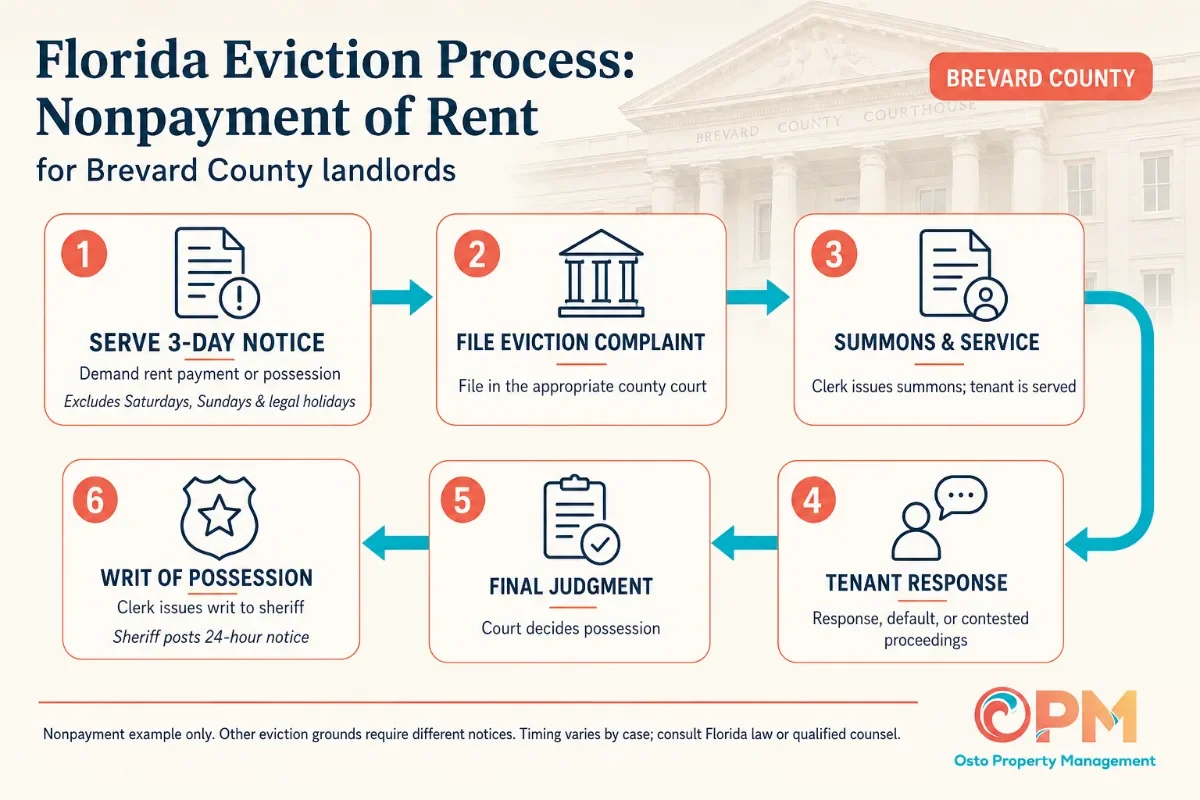
Step 1: Serve the correct written notice
The process starts with the right notice, and the notice depends on why you are evicting:
- Nonpayment of rent - the 3-day notice. Under Statute 83.56(3), you serve a written Florida 3-day notice demanding payment or possession. The three days exclude weekends and legal holidays. If the tenant pays in full within the window, the matter ends there.
- Lease violation - a 7-day notice. Under Statute 83.56(2), a curable violation gets a 7-day notice to cure; a serious or repeated non-curable violation gets a 7-day notice to terminate.
- End of a month-to-month tenancy. Florida requires at least 30 days' written notice before the end of the monthly period to terminate a month-to-month tenancy.
Most Florida evictions that fail, fail on the notice - wrong number of days, counting weekends, or the wrong amount demanded. An incorrectly served notice can force you to start over. Have the notice reviewed before you serve it.
Step 2: File the eviction in Brevard County Court
If the tenant does not comply with the notice, you file an eviction action (a "complaint for removal of tenant") with the Brevard County Clerk of Courts. You file the complaint, a copy of the lease, the notice you served, and pay the filing and service fees. The clerk issues a summons, which is served on the tenant - typically by the sheriff or a process server.
Step 3: The tenant's five days to respond
Once served, the tenant has 5 business days (excluding weekends and holidays) to file a written response with the court. Critically, to contest an eviction for nonpayment, the tenant must generally deposit the disputed rent into the court registry. If the tenant does not respond or fails to deposit the rent, you can move for a default judgment.
Step 4: Judgment and the writ of possession
If you prevail - by default or after a hearing - the court enters a judgment for possession. The clerk then issues a writ of possession, which the Brevard County Sheriff posts on the property. The tenant is typically given 24 hours after the writ is posted to vacate. Only after that can the sheriff oversee removal and you retake possession.
An uncontested Brevard eviction commonly runs about two to four weeks from filing to writ. A contested case, or a court backlog, extends that. The notice period runs before filing, so build in a few extra days at the front.
After the writ: money owed and the security deposit
Regaining possession and collecting what you are owed are two separate things. A judgment for possession returns the property; recovering unpaid rent and damages may require a separate money judgment, which you then have to collect. Apply the tenant's security deposit against unpaid rent and damage according to the notice-and-claim rules in Statute 83.49 - and document the condition of the unit with dated photos before and after. For many Brevard owners, the practical lesson is that thorough tenant screening up front prevents far more losses than any collection effort recovers afterward.
What NOT to do: self-help eviction is illegal
Florida Statute 83.67 flatly prohibits self-help eviction. You may not change the locks, shut off the power or water, remove the doors, or haul the tenant's belongings to the curb - even if they are months behind. Doing so can make you liable to the tenant for actual and statutory damages plus attorney's fees, and it can sink your otherwise-valid case. The only lawful path to removing a tenant runs through the court and the sheriff.
Osto PM manages the notice-to-writ process for Brevard County owners - correct notices, court filings, and coordination with the sheriff - so an eviction is handled by the book. Ask about our full-service Space Coast property management.
Frequently Asked Questions
How long does the eviction process take in Florida?
An uncontested Florida eviction commonly takes about two to four weeks from filing to a writ of possession. If the tenant files a defense or the court is backlogged, it can take longer. The required notice period comes before filing and adds a few days on top.
What is a Florida 3-day notice?
For nonpayment of rent, Florida Statutes 83.56(3) requires the landlord to serve a written 3-day notice demanding rent or possession. The three days exclude Saturdays, Sundays, and legal holidays. If the tenant pays in full within that window, the eviction cannot proceed on that ground.
Can a landlord evict a tenant without going to court in Florida?
No. So-called self-help eviction - changing the locks, shutting off utilities, or removing a tenant's belongings - is illegal in Florida under Statute 83.67 and can expose the landlord to damages. Only the sheriff, acting on a court-issued writ of possession, may remove a tenant.
What is the difference between a notice to cure and a notice to terminate?
For a lease violation other than nonpayment, Florida Statute 83.56(2) generally requires a 7-day notice to cure for a fixable violation (giving the tenant a chance to correct it) or a 7-day notice to terminate for a serious or repeat violation that cannot be cured.
Who removes the tenant at the end of a Florida eviction?
After the court enters a judgment for possession, the clerk issues a writ of possession, and the Brevard County Sheriff posts it and carries out the removal. The landlord never removes the tenant personally.